

Oxxynea® - Polyphenol Concentrate
Oxxynea® is a plant‑based ingredient providing naturally occurring polyphenols from fruit and vegetable sources. It provides a characterised diversity of over 100 polyphenols protecting the metabolism over 24 hours. Supported with a clinical study. Data are available to support polyphenol equivalence aligned with recommended fruit and vegetable intake, from 90 mg/day.
Polyphenols and fruit & vegetable intake
The nutritional benefits of fruits and vegetables arise from the combined presence of vitamins, minerals, fibres, and polyphenols.
Polyphenols are naturally occurring compounds in plant‑based foods and represent a major source of dietary antioxidants. Due to their rapid metabolism and limited storage in the body, regular dietary exposure is required.
Health authorities recommend consuming five servings of fruits and vegetables per day (FAO/WHO, 2004).
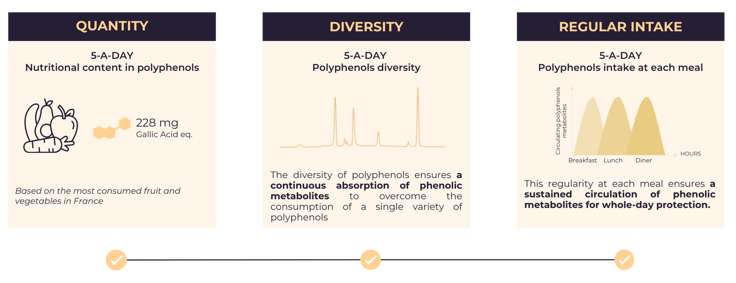
Oxxynea® is a dietary supplement ingredient developed to provide naturally occurring polyphenols from fruit, vegetable, and botanical sources, helping bridge the polyphenol intake gap observed in modern dietary patterns.
Oxxynea® is designed to complement dietary intake and is not intended to replace a balanced and varied diet.
Oxxynea® - Key features
-
FILL THE NUTRITIONAL GAP
A daily intake of 90 to 450 mg/day provides the same quantity of polyphenols as in 1 to 5 servings of fruits and vegetables - 7 SELECTED BOTANICALS
-
100+ POLYPHENOLS IDENTIFIED
-
24-HOUR PHENOLIC LOAD
Nutrikinetic study confirms a sustained release of metabolites from the diversity of bioactive polyphenols -
PROVEN EFFICACY TO MAINTAIN REDOX HOMEOSTASIS
Clinically proven metabolic protection
Oxxynea® is not intended to replace a balanced and diverse diet.
Science supporting Oxxynea®
Oxxynea® has been evaluated in a double‑blind, randomised, placebo‑controlled clinical study conducted in healthy subjects using a cross‑over design. The study was designed to assess the nutrikinetics and acute effects of selected polyphenols, with a focus on their involvement in redox‑related physiological processes during the post‑prandial period.
Characterisation

Composition: Green olive extract (Olea europaea L.), Grape extract (Vitis vinifera L.), Pomegranate extract (Punica granatum L.), Green tea extract (Camellia sinensis (L.) Kuntze), Grapefruit extract (Citrus paradisi Macfad), Bilberry extract (Vaccinum myrtillus L.), Citrus hesperidin (Citrus sinensis (L.) Osbeck).
SPECTRUM OF POLYPHENOLS
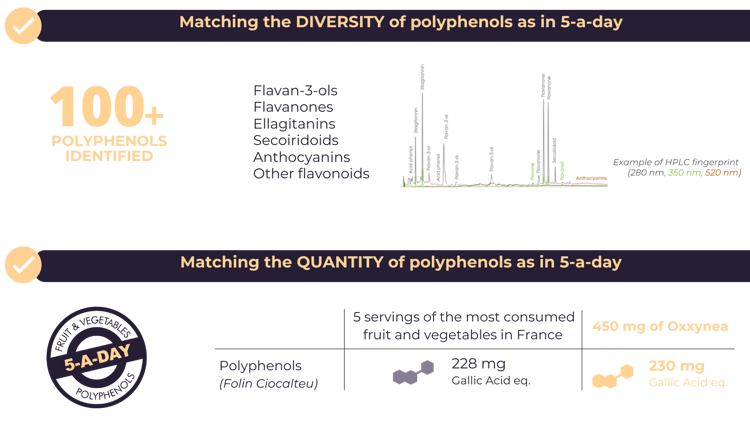
Oxxynea® delivers a characterised spectrum of more than 100 polyphenols, from five main families of compounds: flavan-3-ols, flavanones, ellagitannins, secoiridoids, and anthocyanins.
Primary active compounds
Total polyphenols (eq. gallic acid) ≥ 51%
Recommended daily dosage: from 90 mg/day
Oxxynea® provides polyphenols as in several portions of fruit and vegetables.
90 mg/day Polyphenols as in 1 serving of F&V
180 mg/day Polyphenols as in 2 servings of F&V
270 mg/day Polyphenols as in 3 servings of F&V
360 mg/day Polyphenols as in 4 servings of F&V
450 mg/day Polyphenols as in 5 servings of F&V
Clinically supported benefits
A double‑blind, randomised, placebo‑controlled cross‑over study* was conducted in healthy subjects to investigate Oxxynea® in a controlled clinical setting.
This study was designed to support mechanistic and nutrikinetic understanding, including:
- The nutrikinetics of phenolic compounds
- Exploratory effects related to biological and physiological homeostasis
|
LOCATIONS |
Murcia, Spain |
|
DURATION |
Acute study |
|
POPULATIONS |
10 subjects |
|
PROTOCOLS |
Cf graphic below |
|
INTAKES |
CAPSULE |
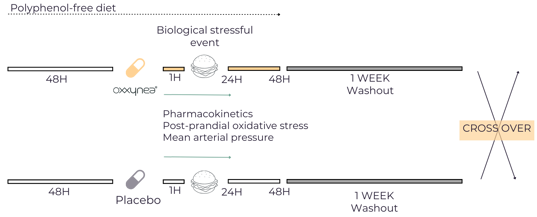
*In cross-over studies, the participants will be switched throughout to all the treatment groups (both formulations and placebo) after a washout period.
The findings contribute to scientific knowledge of Oxxynea®’s behaviour and biological relevance, without constituting full clinical substantiation for health claims.
24‑hour phenolic exposure

Clinical investigations have shown that a single intake of Oxxynea® delivers phenolic metabolites detectable over a 24‑hour period.
This extended exposure is attributed to the diversity of polyphenols sourced from multiple botanical origins, resulting in both early‑phase and delayed appearance of circulating metabolites.
The observed nutrikinetic profile reflects a triphasic absorption pattern, with the initial presence of human phase II metabolites followed by later microbiota‑derived metabolites, as assessed in clinical conditions.
Diet‑mimicking nutrikinetics
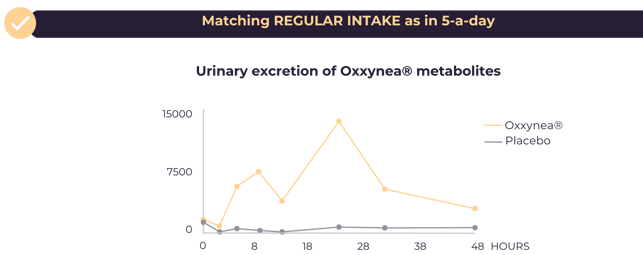
The phenolic absorption profile associated with Oxxynea® has been compared to that of a diversified diet consumed across multiple meals, where different foods contribute a range of polyphenols throughout the day.
This dietary‑like exposure has been explored as a way to support continuous circulation of phenolic metabolites over time, rather than short‑lived peaks linked to single‑source polyphenols.
Consistency of phenolic bioavailability
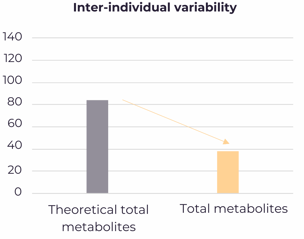
The use of polyphenols from several botanical origins has been investigated for its potential to limit inter‑individual variability in absorption, as observed in clinical settings.
This characteristic has been studied as a way to support more consistent phenolic bioavailability across individuals, compared with formulations based on fewer or isolated phenolic compounds.
Post‑prandial metabolic balance
Oxxynea® has been evaluated in the context of post‑prandial metabolic responses, particularly during high‑fat and high‑carbohydrate meal challenges.
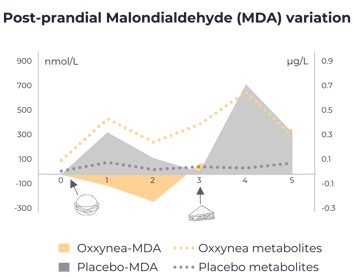
Malondialdehyde (MDA), a recognised biomarker of lipid peroxidation, was assessed following meal intake. In this setting, lower post‑prandial MDA levels were observed with Oxxynea® supplementation compared with placebo, within the conditions of the study.
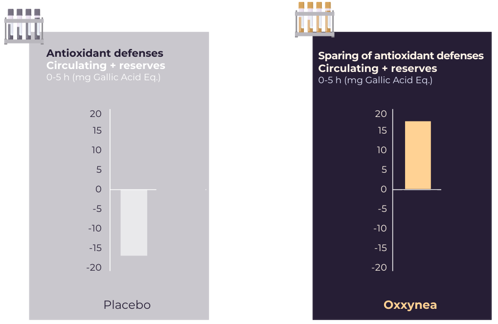
Markers related to endogenous and dietary antioxidant status were also examined, indicating maintenance of antioxidant defences during the post‑meal period.
Physiological parameters beyond antioxidant markers
Beyond oxidative stress–related outcomes, circulating phenolic metabolites derived from Oxxynea® were explored in relation to physiological parameters, including mean arterial pressure (MAP).

Within the clinical study framework, an association between circulating phenolic metabolites and 24‑hour MAP variation was observed, supporting further investigation into the broader physiological relevance of polyphenol exposure.
Oxxynea® is safe
No adverse event linked to Oxxynea® supplementation has been recorded.
Certifications & Compliance
Non-GMO, Halal, gluten-free, suitable for vegans
References
Romain et al.; Nutrients, 2022, 14, 4913
This website is intended to provide information about Biotexia’s ingredients, used in various food/dietary supplement products around the world. It is only intended for business to business and to provide information to food/dietary supplement professionals and is not designed for the general public. Statements used on this website have not been evaluated by competent authority. Products are not intended to diagnose, treat, cure or prevent any disease.